Facts About Indonesia: 40 Verified Facts, Figures & Records (2026)
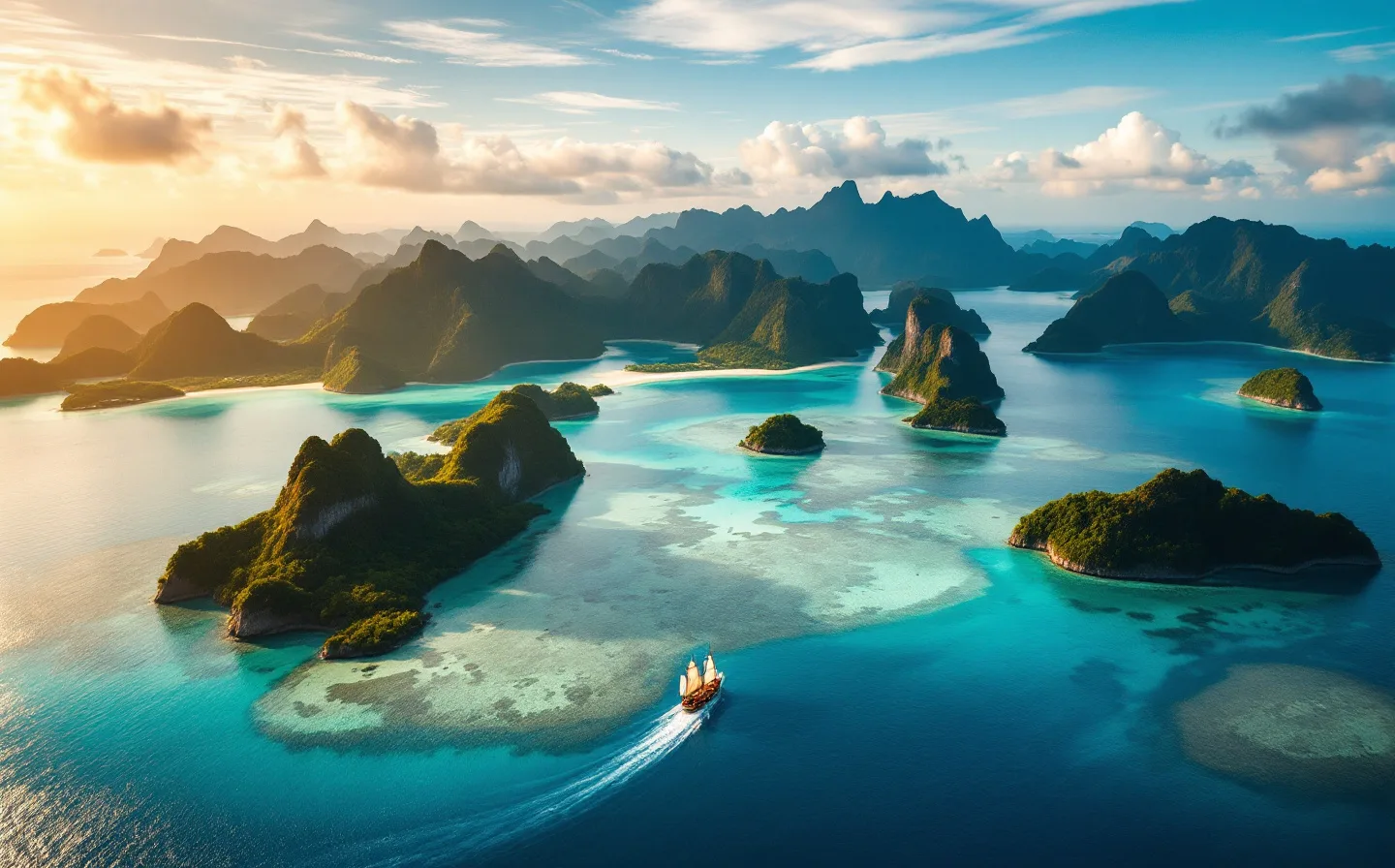
How many islands does Indonesia really have? The official answer is 17,380 islands, registered with coordinates by Badan Informasi Geospasial (BIG), Indonesia’s national geospatial agency, as of 2024 — making Indonesia the largest archipelagic state on Earth. It is also the world’s 4th most populous country (284.4 million people, BPS 2025), home to more than 700 living languages, 127 active volcanoes, the largest lizard, the largest single flower, and the largest Buddhist temple on the planet. This page collects 40 verified facts about Indonesia, organized by category, each with its figure, data year, and named source — so you can quote them with confidence.
Table of Contents
Indonesia at a Glance: Key Numbers
| Indicator | Figure | Source (Year) |
|---|---|---|
| Officially registered islands | 17,380 | Badan Informasi Geospasial (2024) |
| Provinces | 38 | Government of Indonesia (2025) |
| Population (mid-year) | 284.4 million — 4th in the world | BPS – Statistics Indonesia (2025) |
| Living indigenous languages | 703 | Ethnologue (2025) |
| Active volcanoes | 127 | Geological Agency, Ministry of Energy and Mineral Resources (2025) |
| Time zones | 3 (WIB, WITA, WIT) | Government of Indonesia |
| UNESCO World Heritage Sites | 10 | UNESCO World Heritage Centre (2024) |
| UNESCO Intangible Cultural Heritage elements | 15 | UNESCO (2008–2024) |
| Recorded bird species | 1,835 | Burung Indonesia (2025) |
| Documented mammal species | 777 — the most of any country | Mammal Diversity Database (Dec 2025) |
| Foreign tourist arrivals (national) | ±15.3 million | Ministry of Tourism (2025) |
| Economy rank | Largest in Southeast Asia, 16th globally | World Bank (2026) |
Geography Facts About Indonesia
1. Indonesia has 17,380 officially registered islands
Older references still quote “17,508 islands,” but the authoritative count is 17,380 named islands with recorded coordinates in the SIPULAU national island database maintained by Badan Informasi Geospasial (BIG, 2024). The number changes slightly as surveys verify new islands — 63 were added in the 2024 update alone.
2. It is the largest archipelagic state in the world
No other country comes close to Indonesia’s combination of island count and territorial reach. The archipelago spans roughly 46 degrees of longitude, from Sabang at about 95°E to the Papua border at about 141°E — a west-to-east extent wider than the continental United States (timeanddate; Britannica, 2026). Wondering which islands deserve your itinerary first? See our guide to the most beautiful islands in Indonesia.
3. Indonesia sits directly on the equator
The territory straddles latitude 0°, with major islands lying both north and south of the equator (Britannica, 2026). The result is a hot, humid tropical climate year-round, with a wet and a dry season instead of four seasons.
4. The country spans three time zones
Indonesian law recognizes three official time zones: WIB (UTC+7) for the west including Jakarta, WITA (UTC+8) for Bali, Nusa Tenggara and Sulawesi, and WIT (UTC+9) for Maluku and Papua (Government of Indonesia timekeeping regulations).
5. Indonesia has 38 provinces
Following the creation of new provinces in Papua, Indonesia now administers 38 provinces, nine of which hold special or special-autonomous status (Government of Indonesia, 2025). Total national territory covers about 1.89 million km² of land and inland waters (Britannica, 2026).
People and Language Facts
6. Indonesia is the world’s 4th most populous country
BPS – Statistics Indonesia recorded a mid-year population of 284,438,800 people in 2025, behind only India, China, and the United States. The median age is around 31 years — a strikingly young population for an economy this size.
7. More than 700 living languages are spoken
Ethnologue’s current country profile lists 703 living indigenous languages in Indonesia — roughly one in nine of all languages on Earth (Ethnologue, 2025). Bahasa Indonesia serves as the unifying national language taught in every school.
8. Hundreds of ethnic groups live across the archipelago
Indonesia is home to hundreds of distinct ethnic groups, from the Javanese — the largest — to small island communities numbering only thousands. Many maintain living traditions you can still experience today; the best traditional villages in Indonesia offer a direct window into them, including Wae Rebo, the cone-roofed mountain village in Flores.
9. Indonesia has the world’s largest Muslim-majority population
Indonesia is consistently identified in global religion datasets as the country with the largest Muslim population in the world, while its constitution recognizes six religions and the national motto — Bhinneka Tunggal Ika, “Unity in Diversity” — reflects the mix of faiths across the islands.
10. It is one of the youngest large economies on Earth
With a median age of about 31.4 years (international demographic datasets, 2025), more than half of Indonesians were born after 1990 — one reason the country’s digital economy and travel scene evolve so quickly.
Wildlife Facts About Indonesia
11. The Komodo dragon exists nowhere else on Earth
The Komodo dragon (Varanus komodoensis), the largest living lizard, is endemic to a handful of Indonesian islands — Komodo, Rinca, Flores, Gili Motang, and Padar. Males reach about 3 meters in length; the largest verified captive specimen measured 3.13 m and 166 kg (zoological records). Popular claims of “4-meter dragons” are not supported by verified measurements. You can see them in the wild inside Komodo National Park — here is how to get to Komodo Island, or explore a full Komodo Island tour itinerary.
12. Indonesia has more mammal species than any other country
The Mammal Diversity Database (American Society of Mammalogists) counted 777 documented mammal species in Indonesia as of December 2025 — edging out Brazil (776) and China (710) for the world’s highest national total.
13. The world’s largest single flower blooms in Sumatra
Rafflesia arnoldii holds the Guinness World Record for the largest single flower: a specimen measured 111 cm across in West Sumatra in January 2020. The parasitic bloom can weigh up to 11 kg and famously smells of decaying flesh to attract pollinating flies.
14. Orangutans survive only on Sumatra and Borneo
Asia’s only great apes live exclusively in the rainforests of Sumatra and Borneo (primatology distribution records). Indonesia is one of only two countries on Earth where you can encounter wild orangutans — a cornerstone of its megadiverse-country status.
15. Raja Ampat holds the richest marine biodiversity ever surveyed
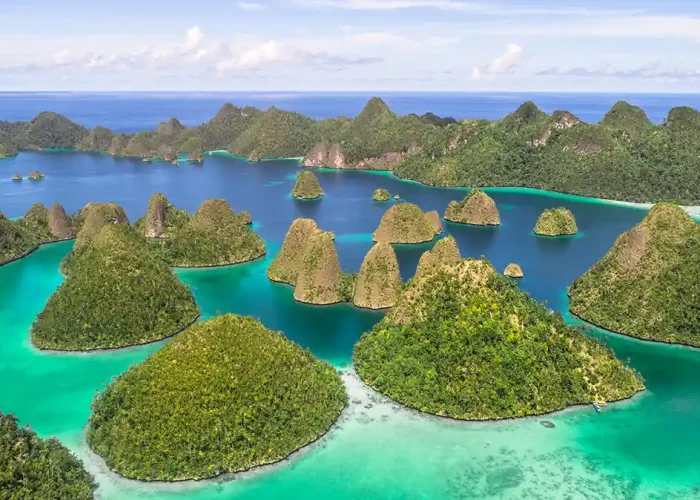
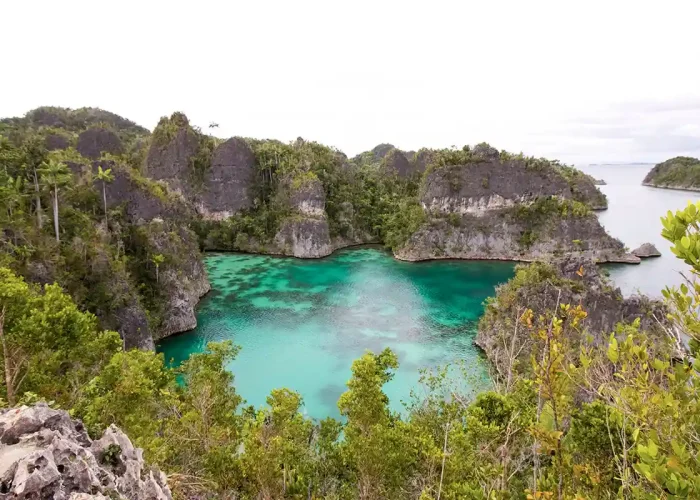
Surveys linked to Conservation International recorded about 1,397 fish species in the wider Raja Ampat region, with reef systems often summarized as containing around 75% of the world’s known coral species. Divers routinely call it the global epicenter of marine life — see our guide to Indonesia’s best underwater destinations and where to swim with sea turtles.
Volcano and Geology Facts
16. Indonesia monitors 127 active volcanoes
The Geological Agency of Indonesia’s Ministry of Energy and Mineral Resources counts 127 active volcanoes out of roughly 500 volcanic structures nationwide (2025) — among the highest totals of any country, a direct consequence of sitting on the Pacific Ring of Fire.
17. Lake Toba was formed by a VEI-8 supervolcano
The Toba eruption around 74,000 years ago ranks at the maximum Volcanic Explosivity Index of 8 — one of Earth’s largest known Quaternary eruptions. The caldera it left behind in North Sumatra is about 100 km long and now holds Southeast Asia’s largest lake (geological syntheses).
18. Kawah Ijen produces electric-blue fire
At Ijen crater in East Java, sulfur-rich gases emerge at up to ~600°C and ignite on contact with air, burning with a blue flame visible only in darkness — typically between 2:00 and 4:30 AM (volcanology explanations based on PVMBG monitoring). It is one of very few places on Earth where the phenomenon occurs at this scale.
19. The archipelago exists because two plates collide
Indonesia’s volcanic arcs formed where the Indo-Australian plate subducts beneath the Eurasian plate. That collision built the dramatic landscapes travelers photograph today — from Bromo’s caldera at sunrise to the savanna ridges of Komodo.
20. Volcanic soil feeds the nation
The same volcanoes that threaten eruptions also deposit mineral-rich ash that makes Java and Bali among the most fertile — and therefore most densely populated — islands in the world. Java alone holds over half of Indonesia’s entire population (BPS).
Culture and Heritage Facts
21. Indonesia has 10 UNESCO World Heritage Sites
The list (UNESCO World Heritage Centre, 2024): Borobudur, Prambanan, Komodo National Park, Ujung Kulon, Sangiran Early Man Site, Lorentz National Park, the Tropical Rainforest Heritage of Sumatra, Bali’s Subak cultural landscape, Ombilin Coal Mining Heritage of Sawahlunto, and the Cosmological Axis of Yogyakarta.
22. Borobudur is the largest Buddhist temple in the world
Guinness World Records certifies the 9th-century Borobudur in Central Java as the world’s largest Buddhist temple: roughly 60,000 m³ of stone, standing 34.5 m tall on a 123 × 123 m base. It was inscribed as UNESCO World Heritage in 1991.
23. The world’s oldest known figurative cave art is Indonesian
A narrative hunting scene at Leang Karampuang, Sulawesi, was dated to at least 51,200 years ago (Nature, 2024) — the oldest known figurative art made by humans. A 2026 Nature study pushed Sulawesi hand-stencil art back further still, to a modeled age of ~71,600 years.
24. 15 Indonesian traditions hold UNESCO Intangible Heritage status
From wayang shadow puppetry and the kris dagger (2008), batik (2009), and angklung (2010) to gamelan (2021), jamu herbal medicine (2023), and kebaya plus Reog Ponorogo (2024) — UNESCO has inscribed 15 Indonesian cultural elements between 2008 and 2024.
25. Traditional pinisi shipbuilding is UNESCO-listed too
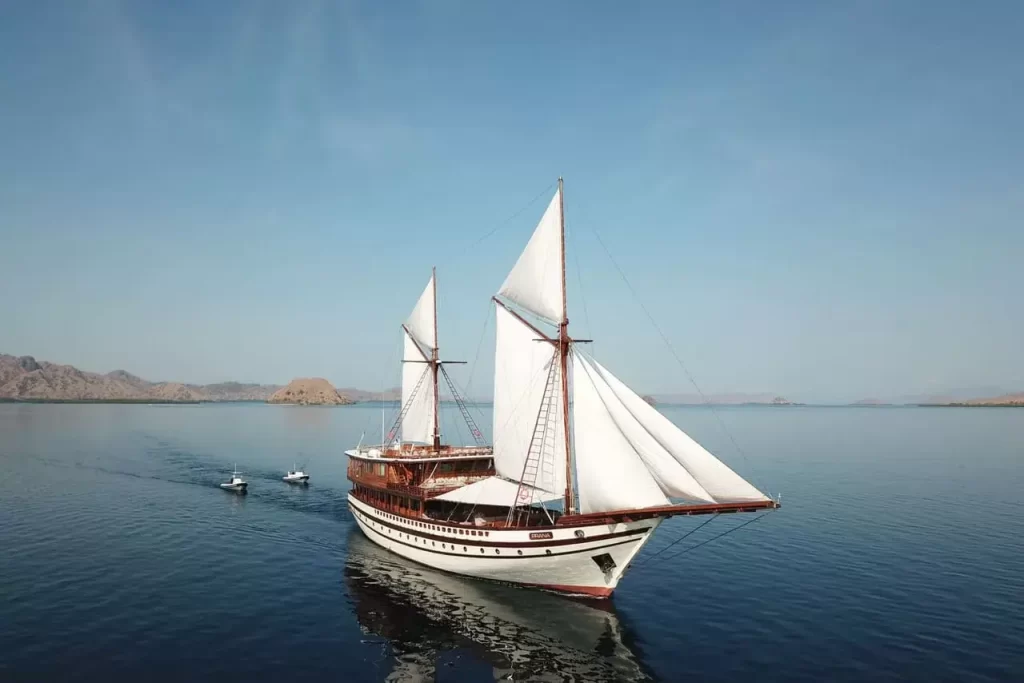
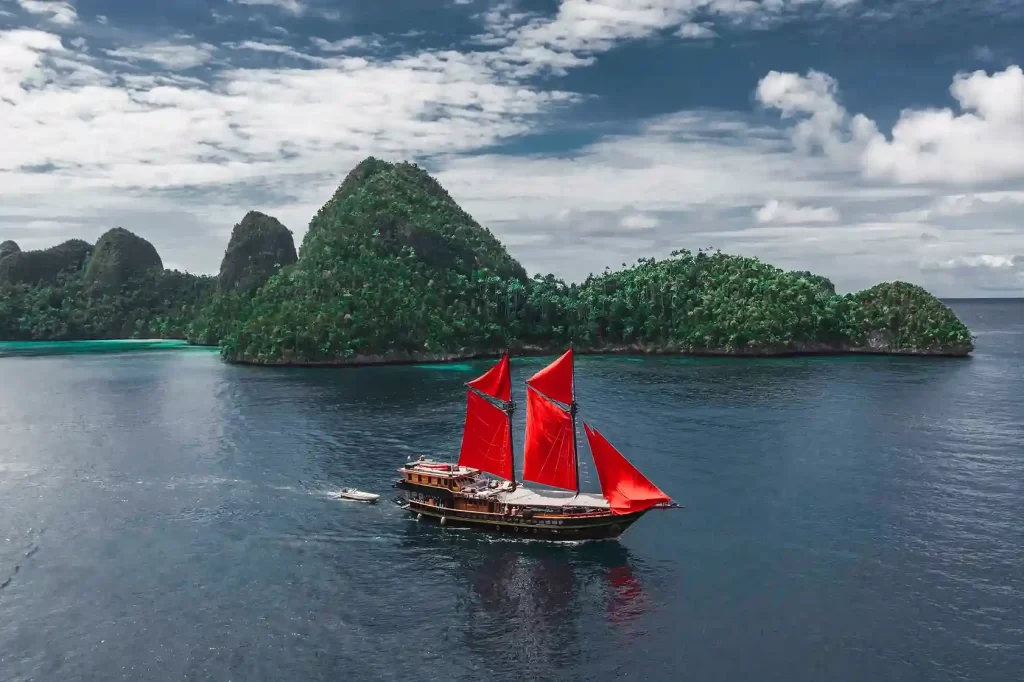
The art of boatbuilding in South Sulawesi — the two-masted wooden pinisi (phinisi) schooner — was inscribed by UNESCO in 2017. The same craft tradition builds the liveaboard vessels that today sail travelers through Komodo and Raja Ampat.
Food Facts About Indonesia
26. Rendang was voted the world’s most delicious food
In CNN’s “World’s 50 Best Foods” readers’ poll — more than 35,000 votes — West Sumatra’s slow-cooked beef rendang took the #1 spot, a result CNN republished in 2017. Indonesian cuisine is the only one with two dishes in the top two.
27. Nasi goreng ranked #2 in the same global poll
Indonesia’s smoky fried rice, nasi goreng, claimed second place in CNN’s poll — meaning the top two “best foods in the world” both come from Indonesia. You will find a different regional version on nearly every island.
28. Tempeh is Indonesia’s gift to global nutrition
Fermented soybean tempeh originated on Java, documented in Indonesian cultural heritage records long before it appeared in health-food stores worldwide. It remains a daily protein staple across the country.
29. The original Spice Islands are in Indonesia
The Maluku Islands were the world’s primary source of nutmeg and cloves during the early modern spice trade — spices once worth more than their weight in gold in Europe, which drew Portuguese, Dutch, and British fleets to the archipelago (historical trade records).
30. Kopi luwak is among the world’s most expensive coffees
Indonesia’s civet-processed kopi luwak is consistently reported among the most expensive coffees on Earth, with specialty lots commanding several hundred US dollars per kilogram in international markets (market reporting, 2024). Exact prices vary widely by origin and certification.
Economy and Records
31. Indonesia is Southeast Asia’s largest economy
The World Bank describes Indonesia as the largest economy in Southeast Asia, ranked 16th globally by GDP (World Bank country profile, 2026), and it is the region’s only permanent member of the G20.
32. It is the world’s #1 nickel producer
Indonesia produced approximately 54% of the world’s nickel ore in 2023 (United States Geological Survey) — the metal at the heart of the global electric-vehicle battery supply chain. It is also the world’s largest palm-oil producer (USDA data).
33. Grasberg in Papua is one of the largest gold and copper mines on Earth
The Grasberg mining complex produced 52.9 tonnes of gold, 680,000 tonnes of copper, and 190 tonnes of silver in 2023 (industry production statistics), placing it among the world’s largest gold and copper operations by output.
34. Indonesia is building a brand-new capital city
Under Presidential Regulation No. 79 of 2025, Nusantara (IKN) in East Kalimantan is targeted to become Indonesia’s political capital by 2028. Jakarta legally remains the capital until a formal presidential decree transfers the seat of government.
35. Indonesian is one of the easiest major languages to start learning
Bahasa Indonesia uses the Latin alphabet, has no verb conjugations, no grammatical gender, and no tones — which is why linguists routinely class it among the most accessible major world languages for beginners. A few phrases go a long way with locals.
Travel Facts About Indonesia
36. Komodo National Park is a UNESCO site and a New 7 Wonder of Nature
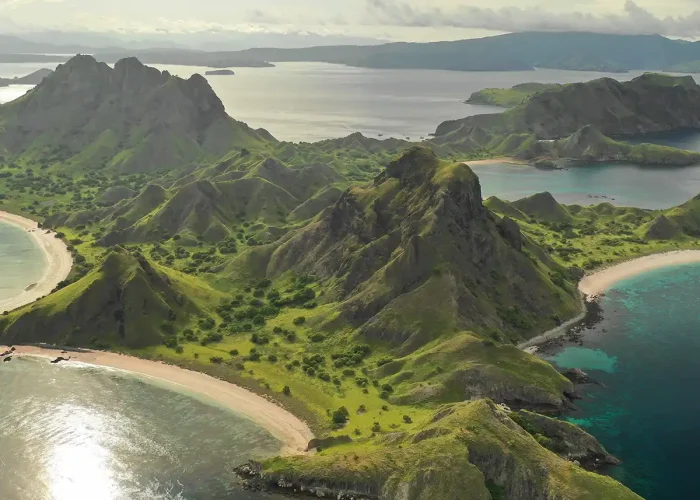
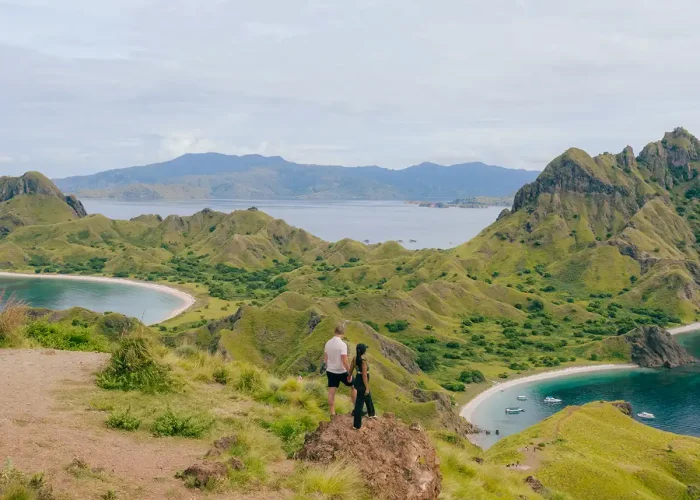
Inscribed by UNESCO in 1991, Komodo National Park was also named one of the New 7 Wonders of Nature in 2012 (New7Wonders Foundation, cited in UNESCO periodic reporting). Its pink-sand beaches and Padar Island viewpoints are now icons of Indonesian travel.
37. Bali welcomed almost 7 million foreign visitors in 2025
BPS Bali recorded 6,948,754 direct foreign arrivals in 2025, up 9.72% from 2024 — while Indonesia as a whole was projected to receive about 15.3 million foreign visitors (Ministry of Tourism, 2025). Yet Bali is only one island out of 17,380.
38. One of the world’s best sunrise views costs a pre-dawn hike
From Borobudur’s stupas at dawn to Mount Bromo’s sea of sand and Padar Island’s triple-bay ridge, Indonesia’s signature experiences share one rule: start before sunrise. Each sits in a different province — and often a different time zone.
39. Entire islands here specialize in single experiences
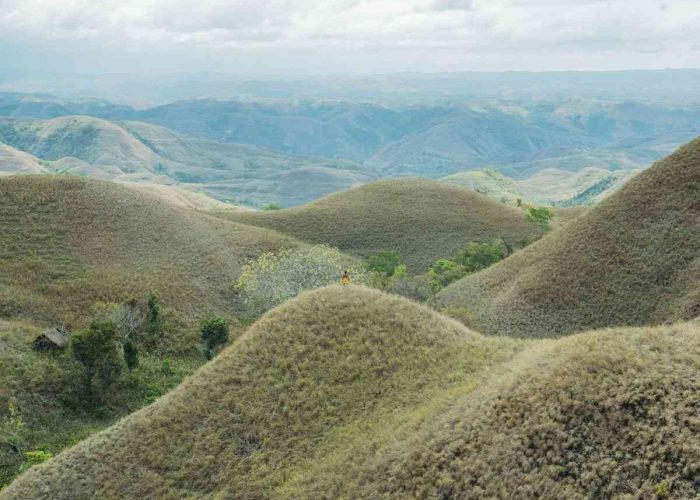
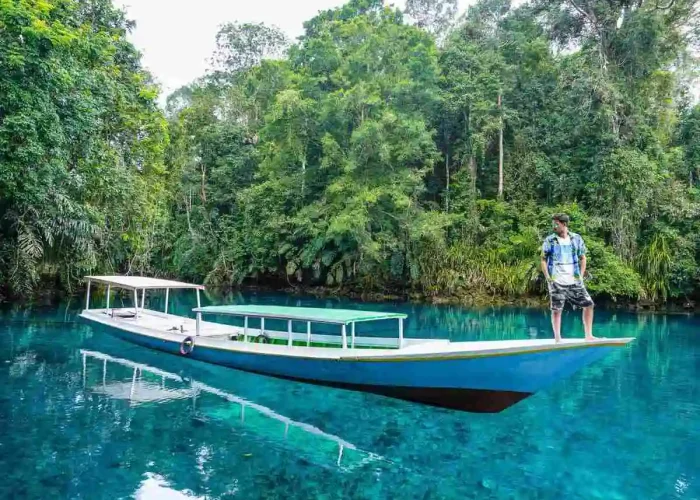
Sumba is famous for its megalithic villages and wild horses — see our Sumba facts guide — Derawan for turtles and stingless jellyfish, and Flores for Komodo dragons and the spider-web rice fields. Island-hopping is not optional in Indonesia; it is the whole point.
40. The best way to see the archipelago is from the deck of a boat
With most of its territory being water, Indonesia’s signature journeys happen at sea — multi-day sailing trips aboard UNESCO-recognized phinisi schooners through Komodo, Raja Ampat, and beyond. It is the one travel experience that connects nearly every fact on this list: the islands, the dragons, the reefs, and the shipbuilding heritage.
Frequently Asked Questions
How many islands does Indonesia have?
Indonesia has 17,380 officially registered islands according to Badan Informasi Geospasial (BIG), the national geospatial agency, as of 2024. Older figures such as 17,508 come from earlier, unverified compilations.
What is Indonesia most famous for?
Indonesia is best known for Bali, Komodo dragons, Borobudur temple, Raja Ampat’s coral reefs, and its status as the world’s largest archipelago with more than 700 languages and 127 active volcanoes.
Is Indonesia the largest archipelago in the world?
Yes. Indonesia is the world’s largest archipelagic state, with 17,380 registered islands spanning about 46 degrees of longitude between the Indian and Pacific Oceans.
How many languages are spoken in Indonesia?
Ethnologue lists 703 living indigenous languages in Indonesia — about one in nine of the world’s languages. Bahasa Indonesia is the official national language spoken across the country.
What is the best way to explore Indonesia’s islands?
For island regions like Komodo and Raja Ampat, multi-day boat trips aboard traditional phinisi vessels are the most practical way to reach multiple islands in one journey. Land-based trips work best for Java’s temples and volcanoes, Bali, and Sumba.
Sources
- Badan Informasi Geospasial — SIPULAU national island database (2024)
- BPS – Statistics Indonesia — Mid-Year Population (2025)
- Ethnologue — Languages of Indonesia (2025)
- UNESCO World Heritage Centre — Indonesia (2024)
- UNESCO Intangible Cultural Heritage — Indonesia (2008–2024)
- Guinness World Records — Largest Buddhist temple (Borobudur)
- Guinness World Records — Largest single flower (Rafflesia arnoldii, 2020)
- Nature — Dating of Sulawesi rock art (2024/2026)
- Burung Indonesia — The State of Indonesia’s Birds (2025)
- World Bank — Indonesia country overview (2026)
- United States Geological Survey — Nickel statistics (2023)
- CNN Travel — World’s 50 Best Foods readers’ poll
- BPS Bali via Antara News — Bali foreign arrivals (2025)
- UNESCO — Komodo National Park (Site 609)